SIRUI Review 2026

SIRUI Review 2026: Is It Worth Buying?
SIRUI is legit — and for independent filmmakers or photographers on a budget, it may be the most practical decision you make this year. The Chinese-based brand has spent 25 years building camera lenses, tripods, and lighting gear that consistently outperform their price tags. If you've seen their anamorphic lenses trending in filmmaking communities and want to know whether they live up to the hype: they largely do, with a few honest caveats.
⭐ Overall Rating: 4.2/5
✅ Best for: Indie filmmakers, hybrid creators, and budget-conscious photographers who want cinematic results without paying first-party prices
❌ Not ideal for: Videographers who need fast, reliable autofocus for run-and-gun work — or anyone who may need to make a return
💰 Price Range: ~$70 – $1,599
🔗 Visit SIRUI →
What Is SIRUI?
SIRUI is a Guangdong, China-based manufacturer founded in 2001, now with over 60 patents and recognition from both the Red Dot Design Award and the German Design Award (2018). They produce anamorphic and cine lenses, autofocus lenses, carbon fiber tripods, gimbal heads, and LED lighting — all aimed at delivering professional-grade imaging tools at a fraction of what legacy brands charge.
Their distribution network means US customers receive orders from domestic or nearby regional warehouses — not direct from China — with standard delivery in 3–7 business days. For US-based creators comparing shipping times, that's competitive with most direct-to-consumer brands.
What sets SIRUI apart is the democratization play: they turned anamorphic lenses — once a $10,000-and-up territory — into a sub-$500 purchase. That repositioning is what built their reputation in indie film circles, and it's hard to argue with the results on screen.
Top SIRUI Products to Know
1. Night Walker T1.2 S35 Cine Lens — from $279
The Night Walker series offers an ultra-fast T1.2 aperture in a lightweight aluminum alloy build with a 12-blade diaphragm and follow-focus gears. Available in 24mm, 35mm, and 55mm, it's designed for APS-C/Super 35 sensors. Customers describe the image character as "stylized" with low contrast wide open — a look many filmmakers actively want. For a cinema lens under $300, it's nearly unmatched.
2. Sniper Series F1.2 APS-C AF Lenses — $299 each / $849 for 3-lens set
Built with carbon fiber, ceramic baked paint, and STM focus motors, the Sniper lenses come in a range of focal lengths for Fujifilm X, Sony E, and Nikon Z mounts. Reviewers call it an "entry-level game changer" for still photography — the shallow depth of field and bokeh quality rival lenses at three times the price. The caveat: autofocus in video mode can show stepping, making it better suited for stills and hybrid shooting than dedicated video work.
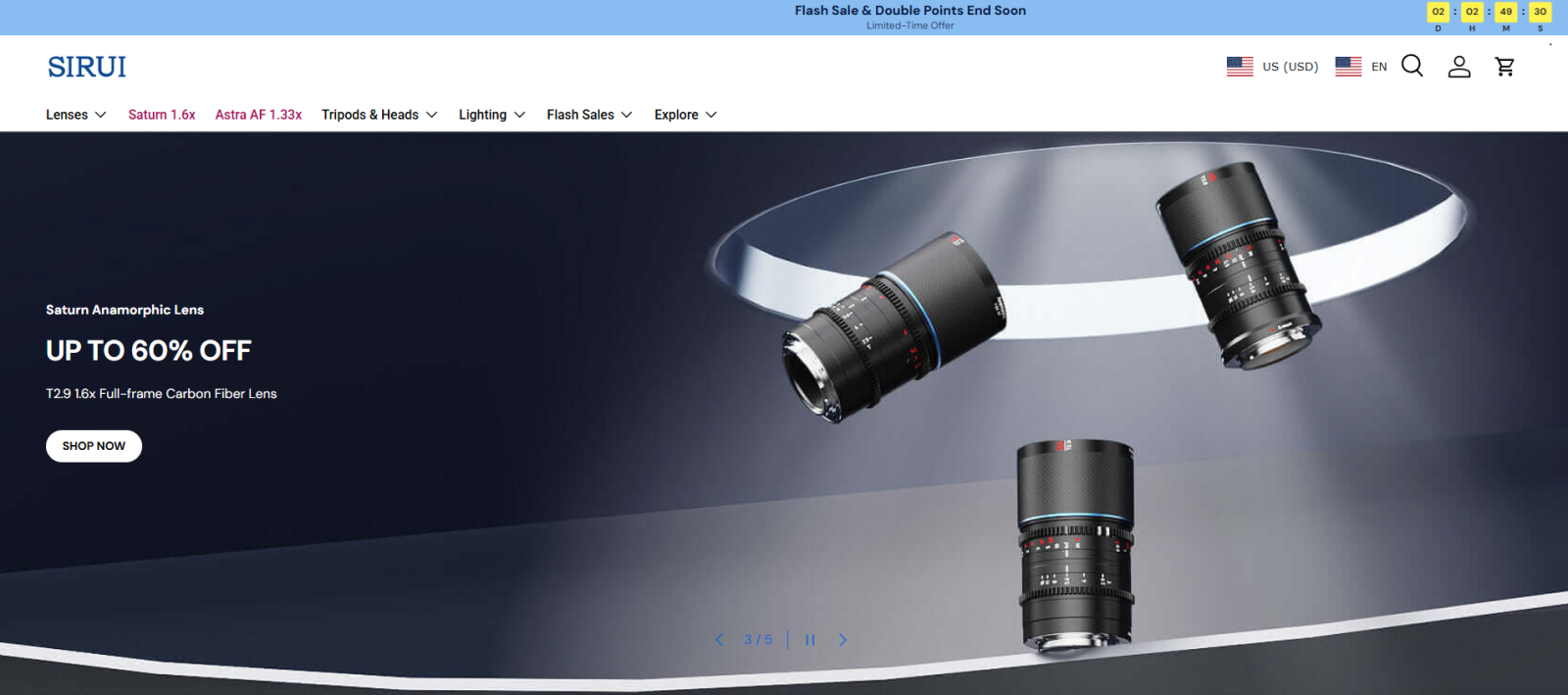
3. Saturn T2.9 1.6x Full-Frame Anamorphic Lens — from $499
The Saturn series made SIRUI famous in indie film circles. A carbon fiber front barrel keeps weight low enough for gimbal use; the 1.6x squeeze delivers genuine horizontal flares and oval bokeh on full-frame sensors. Customers describe it as "changing the anamorphic game" in terms of portability and affordability. If you want the cinematic anamorphic look without a cinema budget, this is where most people start.
4. Venus Full-Frame 1.6x Anamorphic Lens — from $499
The Venus line is SIRUI's more substantial, professional-grade anamorphic series — heavier build, often requiring lens support, but praised for "top notch" image quality. It's frequently cited as the best anamorphic value in the market for independent production teams shooting on large-format cinema cameras. If the Saturn is the travel-friendly option, the Venus is the "production set" choice.
5. AM-225 Carbon Fiber Tripod with B-00K Ball Head
Part of SIRUI's AM Compact Series, this tripod is consistently highlighted for "top-tier" carbon fiber construction that stays light enough for travel without compromising stability. In independent vibration tests, SIRUI tripods have outperformed more expensive Gitzo models. The legs slide out automatically when twist locks are opened — a time-saving detail that reviewers genuinely appreciate in the field.
Pros & Cons
✅ What We Like
- Exceptional value across the board: SIRUI's Aurora 85mm f/1.4 sits at ~$499 versus Sony's equivalent at $1,800 and Sigma's at $1,100. The price gap is real, and the quality holds up.
- Build quality that punches above its price: Customers on Trustpilot and YouTube consistently call SIRUI hardware "solid," with the carbon fiber in the tripod line earning comparisons to brands twice the price.
- Fast US shipping and secure packaging: Multiple Trustpilot reviewers highlight fast delivery (3–7 business days for US orders) and items arriving well-packaged and intact.
- Mechanical innovation: SIRUI's auto-releasing tripod legs and the lightweight anamorphic form factors are genuinely thoughtful engineering choices — not just cost-cutting.
- 6-year tripod warranty: Most competitors cap support warranties at 1–2 years. Six years is a meaningful differentiator for buyers planning long-term use.
⚠️ Worth Knowing
- Returns can be frustrating: Several customers reported complicated return experiences, including unexpected shipping/customs fees they had to cover. If you're unsure about a purchase, read the return policy carefully before ordering.
- Autofocus for video is a limitation: The Sniper series AF is reliable for stills but can produce visible "stepping" in video transitions rather than a smooth cinematic pull. If you're primarily shooting video that demands fast continuous AF, look at Viltrox or first-party options.
- Optical character vs. clinical sharpness: SIRUI lenses have a stylized, sometimes "dreamy" look wide open, with chromatic aberration visible at the edges on some models. Some users consider this a creative feature; others expecting clinical perfection may be disappointed.
- Model numbering is confusing: Reviewers routinely note that SIRUI's model numbers across the tripod and lens lines are difficult to differentiate without cross-referencing specs.
How SIRUI Compares
| Feature | SIRUI | Gitzo / Wimberley (Tripods) | Sony / Sigma (Lenses) |
|---|---|---|---|
| Lens price range | $279–$1,499 | N/A | $1,100–$1,800 (equiv.) |
| Tripod/Gimbal price | ~$370–$400 | $600+ (gimbal head alone) | N/A |
| Ships from | US warehouse | Varies | Varies |
| Tripod warranty | 6 years | Typically 5 years | N/A |
| Camera lens warranty | 3 years | N/A | 1–5 years |
| Anamorphic options | Extensive | None | Limited |
| AF video performance | Moderate | N/A | Excellent |
Shipping & Returns
- Standard US shipping: 3–7 business days (0–1 business day processing)
- Free shipping threshold: $299+ for lenses and lighting / $149+ for tripods and accessories
- Return window: 30 calendar days from receipt
- Return conditions: Unused items in original condition with proof of purchase; opened packaging incurs a packaging and depreciation fee
- Refund type: Cash refund to original payment method
- Warranty: 6 years (tripods/support gear) · 3 years (camera lenses, effective July 1, 2025) · 1 year (lighting)
Frequently Asked Questions
Is SIRUI legit?
Yes. SIRUI is a legitimate manufacturer with 25 years in business, 60+ patents, and multiple international design awards. Their products are sold through their official global store and ship to US addresses from domestic warehouses. Customer reviews on Trustpilot confirm consistent product quality, though some note difficulties with returns.
Is SIRUI worth it for filmmakers?
For indie filmmakers and content creators, yes — especially the Saturn and Venus anamorphic lines. SIRUI makes cinematic tools that previously required budgets far beyond reach. If you need clinical optical perfection or fast video autofocus for professional broadcast work, first-party lenses from Sony or Sigma are a better fit.
How does SIRUI compare to Viltrox or Sigma for autofocus?
SIRUI's Sniper series AF is reliable for stills and light hybrid use, but Viltrox and Sigma consistently outperform it for continuous video autofocus. If smooth, fast AF in video is your primary need, that's the honest answer — SIRUI's strength is in anamorphic and manual cine work, not AF performance.
Why is SIRUI so much cheaper than competitors?
SIRUI owns its entire production chain — from optical engineering to manufacturing — in its own factory in Guangdong. They also launch products through crowdfunding (Indiegogo, Kickstarter), which reduces distribution overhead. The savings pass through to the customer, not a middleman.
What is SIRUI's return policy?
SIRUI accepts returns within 30 days of receipt for unused items in original condition. Returns on opened packaging incur packaging and depreciation fees. Some customers have reported that return shipping and customs costs fall on the buyer — worth confirming with their support team before initiating a return.
Final Verdict
SIRUI has genuinely earned its reputation among indie filmmakers and budget-conscious creators. The anamorphic lenses — particularly the Saturn and Venus lines — deliver a cinematic look that costs a fraction of traditional alternatives, and the carbon fiber tripods offer stability that outperforms more expensive competitors in real-world testing. The 6-year tripod warranty alone is a statement of confidence in the hardware.
The limitations are real too: autofocus in video falls short of Sony or Viltrox, the return process has frustrated some customers, and the optical character won't satisfy everyone. But if your budget is under $500 and you want genuinely cinematic images, few brands offer better value per dollar.
→ Browse more camera & photography deals: couponvoice.com/store/sirui
→ See all our photography & tech reviews on CouponVoice
Reviewed by the CouponVoice Editorial Team. We independently research and review products to help US shoppers make informed decisions. Affiliate disclosure — we may earn a commission via our links at no extra cost to you.